Here is a poem that I wrote in August 2019 about going to primary school in the 1980s and taking fruit that I was meant to eat for morning tea – and often never did. Enjoy.
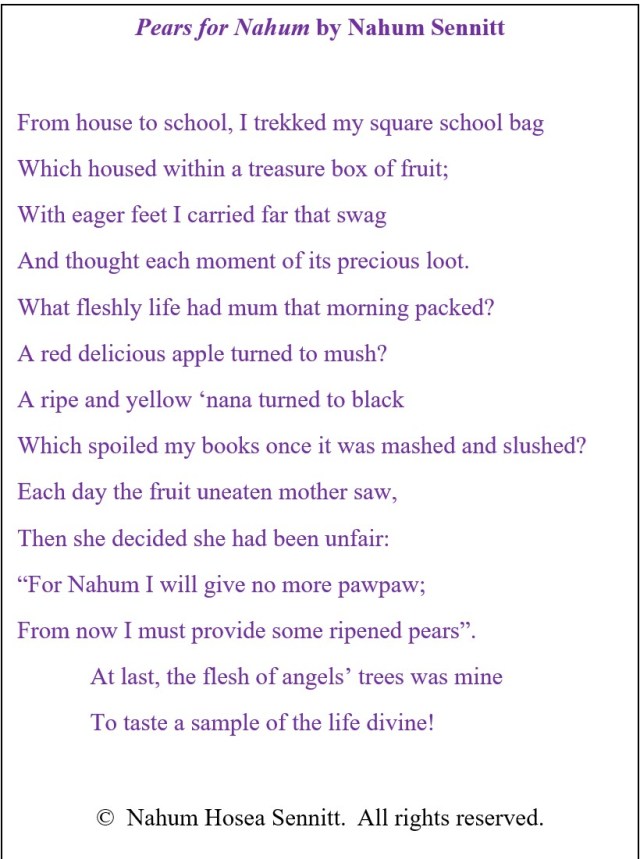
Here is a poem that I wrote in August 2019 about going to primary school in the 1980s and taking fruit that I was meant to eat for morning tea – and often never did. Enjoy.
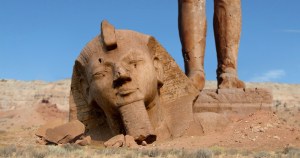
The British poet Percy Shelley, whose wife Mary wrote the gothic horror novel Frankenstein, penned a sonnet about Egyptian pharaoh Rameses II (otherwise known as Ozymandias). It reflects on how man’s achievements, even the greatest on earth, will one day fall and turn to powder:
I met a traveller from an antique land,
Who said, “Two vast and trunkless legs of stone
Stand in the desert. . . . Near them, on the sand,
Half sunk a shattered visage lies, whose frown,
And wrinkled lip, and sneer of cold command,
Tell that its sculptor well those passions read
Which yet survive, stamped on these lifeless things,
The hand that mocked them, and the heart that fed;
And on the pedestal, these words appear:
My name is Ozymandias, King of Kings;
Look on my Works, ye Mighty, and despair!
Nothing beside remains. Round the decay
Of that colossal Wreck, boundless and bare
The lone and level sands stretch far away”.
Throughout the months of April – June this year I have not had as much work as I once had, and have thus had more time to sit down and enjoy some reading. I’m an avid reader and in the last few weeks I’ve read:
Currently I’m getting some other works, but when I came across chapter 13 of No Little People, I read Francis A. Schaeffer’s discussion of the significance of Jesus Christ’s declaration in John 7:36-37 of Him being water that satiates man’s thirst. Schaeffer noted that Jesus said this at the peak moment of the Jewish festival of Sukkoth (John 7:37a) when the Jewish high priest poured water on the Temple altar as a cleansing oblation. The fact that Christ used that moment to declare Himself as being man’s only – and greatest – satisfaction piqued my interest.
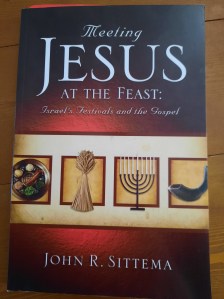 Hungry to know more about the Jewish feasts, I found a short, 152-page book named Meeting Jesus at the Feast: Israel’s Festivals and the Gospel by John R Sittema; the words within its pages helped me to better grasp who Jesus is. What are these feasts? They were 7 distinctive but overlapping festivals that the Israelites were commanded by Yahweh to keep in the 23rd chapter of Leviticus; Israel’s annual calendar revolved around these moments, rather than the agricultural cycle. While some of the feasts, such as The Day of Atonement lasted only a day, others lasted longer, such as the Feast of Tabernacles. Some could be celebrated in the confines of one’s own home (such as the Sabbath) while others involved pilgrimages to Jerusalem, such as Passover. Most were only observed once a year while the Sabbath were more routine; all of them were founded upon God’s salvation and provision. In so many ways it proves that Leviticus is not just a book of ‘boring laws’ that God asked Moses to write, but is a book rich with joy and festal celebration in the life of God’s gathered community.
More importantly is what all these celebrations say about Jesus. Roughly speaking, they worked thus:
There are many other details from Sittema’s book that this short blog post cannot contain, but he has done a terrific job joining the dots between 1) the festivals, 2) Christ’s fulfilment of them, and 3) what the practical implications of them are now for God’s people. If there was one minor criticism it was his using the final chapter about Jubilee to quote NT Wright in mocking people who believe in Rapture. With that being said, it is definitely a book worth reading.
 Liquørice Fjørds