Throughout the months of April – June this year I have not had as much work as I once had, and have thus had more time to sit down and enjoy some reading. I’m an avid reader and in the last few weeks I’ve read:
- Nicholas Nickelby by Charles Dickens (re-read);
- Great Expectations by Charles Dickens (re-read);
- No Little People by Francis A. Schaeffer;
- Being God’s Friend by Charles Spurgeon;
- Hosea (Tyndale Old Testament Commentaries: Volume 24) by David Allen Hubbard
- Others that I cannot recall!
Currently I’m getting some other works, but when I came across chapter 13 of No Little People, I read Francis A. Schaeffer’s discussion of the significance of Jesus Christ’s declaration in John 7:36-37 of Him being water that satiates man’s thirst. Schaeffer noted that Jesus said this at the peak moment of the Jewish festival of Sukkoth (John 7:37a) when the Jewish high priest poured water on the Temple altar as a cleansing oblation. The fact that Christ used that moment to declare Himself as being man’s only – and greatest – satisfaction piqued my interest.
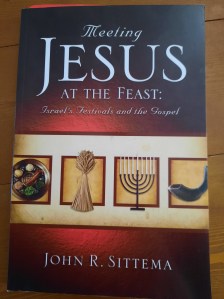 Hungry to know more about the Jewish feasts, I found a short, 152-page book named Meeting Jesus at the Feast: Israel’s Festivals and the Gospel by John R Sittema; the words within its pages helped me to better grasp who Jesus is. What are these feasts? They were 7 distinctive but overlapping festivals that the Israelites were commanded by Yahweh to keep in the 23rd chapter of Leviticus; Israel’s annual calendar revolved around these moments, rather than the agricultural cycle. While some of the feasts, such as The Day of Atonement lasted only a day, others lasted longer, such as the Feast of Tabernacles. Some could be celebrated in the confines of one’s own home (such as the Sabbath) while others involved pilgrimages to Jerusalem, such as Passover. Most were only observed once a year while the Sabbath were more routine; all of them were founded upon God’s salvation and provision. In so many ways it proves that Leviticus is not just a book of ‘boring laws’ that God asked Moses to write, but is a book rich with joy and festal celebration in the life of God’s gathered community.
More importantly is what all these celebrations say about Jesus. Roughly speaking, they worked thus:
- Sabbath, or Ha-Shabbat (הַשַּׁבָּת) – Just as Israel enjoyed a regular day of routine rest, so Jesus alone is our rest that we live no longer by our own strength. Our times and life are to revolve around Him in regular ways that interrupt our routines;
- Passover, or Pesach (פֶּסַח) – Israel could never ever forget what saved them from God’s wrath in Egypt, which also secured their freedom from that tyrant; this was the shedding of the blood of an innocent animal in their place. In the same way, Jesus is the Passover Lamb, whose blood thwarted the wrath of God from being poured out on us and instead was placed on His innocent, sinless Son. That moment also bought us freedom from Satan’s rule over us;
- The Feast of First-fruits, or Chag-Bikkurim (חַג בִּכּוּרִים) – Just as Israel offered up the first crops of their annual harvest as a thanksgiving to Yahweh, so Christ’s saving works are the ‘first fruits’ that is offered up to God. As such God’s people are to live lives of thanksgiving to Him, and we will be God’s first-fruits at Christ’s coming (1 Corinthians 15:20, 23b; 2 Thessalonians 2:13; James 1:18). And as Israelite farmers were to leave food on their fields for the poor to collect, so Christ’s people are to generously give to others around them;
- The Feast of Weeks, or Chag-Shauvot (חַג שָׁבֻעֹת) – The Israelites were to count 49 days (7 x 7, or 7 weeks’ worth of time) and then offer up grain, or bread, offerings in the Temple as a thanksgiving. 7 x 7 signifies perfection multiplied by perfection and Jesus is our perfection and our Bread of Life (John 6:25). Jesus was born in Bethlehem, the name of which ironically means House of Bread. Jesus is bread without leaven (or sin), and it was with bread that He enjoyed a Passover meal before dying for sin (Matt. 26:26). Weeks also was connected to Pentecost and the outpouring of the Holy Spirit;
- The Feast of Trumpets, or Chag-Teruah (חַג תְּרוּעָה) – On this day, the Israelites had to take a day of rest and hear the blasting of trumpets which, among other things, the New Year (Rosh Ha-Shanah) and the need to prepare for war. Since Christ will one day return to earth to judge – something that will sneak up on most ‘like a thief in the night’; before that happens His people are to be always prepared to meet Him and be sober in how they live (1 Thessalonians 5).
- The Day of Atonement, or Yom Kippur (יוֹם הַכִּפֻּרִים) – This day hardly needs describing! But on it the Israelites needed their sins paid for (Leviticus 16 describes this day in great detail). On that day a goat and a bull had their throats lacerated and copious amounts of blood were used to pay for Israel’s sins. Another goat (the scapegoat) bore ‘on its shoulders’ the sins of Israel, and then ‘carried them out’ into wilderness, or was thrown off a cliff. Jesus was both the bull/goat whose blood was shed for sin and the scapegoat who hung on a cross outside the city who carried our sins away (Hebrews 10:1-10).
- The Feast of Booths/Tabernacles, or Chag-Sukkoth (חַג סֻּכּוֹת) – This was a festival that went for a whole week and celebrated God’s provision for Israel in the wilderness, giving God thanks for the provision of their food and water. Psalms 113-118 (the Egyptian Hallel Psalms) were read through the week as the Israelites waved palm fronds to praise God (c.f. John 12:13). Christ is He who provides for His people and is the water for our souls (John 10:10, 7:37); Him we worship not only at home, as individuals but ‘in the streets’ before others. And just as Sukkoth was a long celebration so we will one day enjoy an endless feast with the Father, Son, and Holy Spirit in eternal glory (Psalm 23);
- Sittema also includes the Jubilee festival (שְׁנַת הַיּוֹבֵל, or Shinat Ha-Yovel), which the Israelites were commanded to celebrate in Leviticus 25. Jubilee was meant to occur every 49 years (7 x 7 years) and on that year the Israelites were to cancel all outstanding debts which they had against one another, financial or otherwise; just as God had forgiven Israel, so one man was to forgive one another. But this forgiveness must have been hard to exhibit because there is no record of Israel having ever celebrated Jubilee.
There are many other details from Sittema’s book that this short blog post cannot contain, but he has done a terrific job joining the dots between 1) the festivals, 2) Christ’s fulfilment of them, and 3) what the practical implications of them are now for God’s people. If there was one minor criticism it was his using the final chapter about Jubilee to quote NT Wright in mocking people who believe in Rapture. With that being said, it is definitely a book worth reading.
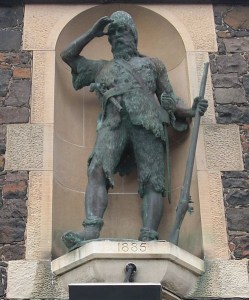 Incidentally, I recently read about Alexander Selkirk (whose commemorative statue is pictured in this picture), was a Scotchman who lived in the 18th century and was believed to have been the inspiration of the character Robinson Crusoe in the book so-named by Daniel Defoe. Marooned on the island of Más a Tierra off the cost of Chile, Selkirk was lived there by himself for 4 years before being rescued by sea captain Woodes Rogers in February 1709. Upon rescuing Selkirk, Rogers thought him so capable that he quickly appointed him to be a captain of one of his vessels.
 Liquørice Fjørds