
Not long ago on this blog I wrote about how I was working on committing the book of The Song of Solomon in the Old Testament to English poetry. I finished it around May of this year, but decided not to publish it. It was a difficult decision to make about not publishing but I have discovered found that getting published is quite difficult these days, more so than ever before. When all is said and done it costs an author today more, financially speaking, to get published than he would making money from it because the cost of printing and distributing them is so expensive – and comes out of the author’s own pocket. To make things more complicated, publishing companies are extremely picky now about whom they wish to publish; Christian publishers are more reluctant than mainstream ones to publish poetry. If you do self-publish (which has been suggested to me many times) marketing and distributing your work is an uphill battle because you don’t have access to supply chains like the companies do. By the time you get paid any royalties for your work (IF you get paid any at all), most (if not all) of it has been taken out by others before you receive a penny of it yourself. In all of this I have found the creative writing process quite enjoyable and inspiring, but the commercial reality quite sobering and even depressing.
That reality though doesn’t impede me from writing. In the last couple of months I have written almost 20 poems of almost 7,000 words, including a 2,400 word short story that was written in poetic meter about a dishwasher that wants to be the queen of a camp-site. (That was written to complete an assignment for a course that I’ve been doing on short story writing.) Of course, I haven’t written at those verses just to accomplish some random word quota, but I’ve had so many ideas for poems that I’ve wanted to put them to paper before I forget all about them. Here is one that I wrote this month. It was written in the form of a rondeau redoublé, where the four lines of Stanza 1 are also the final lines of Stanzas 2, 3, 4, and 5. Additionally, the first four syllables of the first line (‘Like mountain goats’) make what the French call a rentrement, whereby the last words of the poem are the same as the poem’s first words:
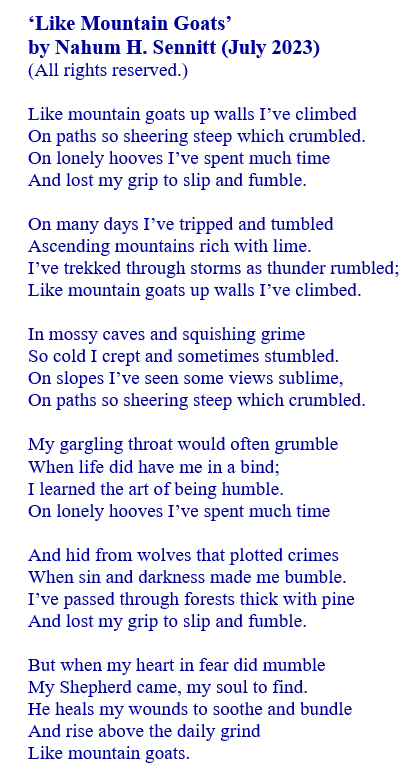
I have really been enjoying my newfound ‘romance’ with poetry, as it has become for me an poignant form of self-expression. I am more than capable of writing prose (after all, I did successfully complete a Masters of Theology!) but that form is expression for the head, while poetry speaks what the heart yearns to say. I began writing poetry again exactly 5 years ago and I feel as though I am now ‘coming into my own’, so to speak, in honing and refining how I express myself poetically. That does not mean though that poetry does not obey particular conventions and ‘rules’ – indeed it does, almost as much as prose is required to do; poets need to pay careful attention to meter, syllables, simile, and metaphor. This is even still a requirement for blank verse, which lacks rhyme. When those conventions are heeded, you get brilliant poetry. When you don’t it simply sounds like rambling that doesn’t even sound like prose!
In my own poetry I really enjoy the French forms with their repeated rhyming lines, such as the villanelle, rondeau, rondeau redoublé, triolet, roundelay, and the rondel. I also love Nordic/Germanic forms like the dróttkvætt with its alliteration and rhyming vowel sounds, which have sadly gone out of fashion and which really stretch a poet’s powers of imagination and expression to their ultimate extremes. However, they are things that give a real challenge and can ‘squeeze out’ of the juice press some amazing lines of verse. Below is an example of a pantoum that I wrote recently, where the lines in a stanza are repeated in the next stanza. The at the end, the first line of the poem is also its final line:


I hope and pray that one day I can get my poetry published, but for now I can just enjoy the writing of it. And it’s so much more rewarding and enjoyable than it was doing paid ministry as a preacher and a pastor!
 Liquørice Fjørds